Что Вы ищете?
An Affordable Helicopter Alternative for MENA and African Firefighting Scenarios
Executive Summary
The Middle East and Africa (MENA) region face unique fire safety challenges, especially when combating high-rise building fires in urban centers and petrochemical infernos in desert oil fields. Traditional firefighting methods—like ground-based water cannons and manned helicopters—are often inadequate, slow to deploy, or prohibitively expensive. These challenges are amplified by the region’s unique climatic conditions, urban growth, and large-scale oil production operations.
The 50kg Heavy Payload Firefighting Drone, designed to deliver unmatched precision, safety, and cost-efficiency, emerges as a disruptive solution. In this paper, we explore how this region-specific drone technology can successfully address Class B fires (oil-based) and high-rise structural fires without putting personnel at risk or requiring multimillion-dollar investments.
Section 1: Why Traditional Firefighting Methods Fail in MENA and Africa
1.1 The High-Rise Building Dilemma
MENA cities (e.g., Dubai, Riyadh, Doha) feature some of the world’s tallest towers. Fires in skyscrapers above the height of conventional ladders (e.g., 30+ floors) are catastrophic threats due to limited access from ground-based equipment. Helicopters, while an option, have severe operational constraints:
Rotor wash (downward air pressure) scatters water, reducing precision.
Helicopters cannot hover stably near a burning window due to heat plumes.
Pilot visibility is severely limited in smoke-filled areas.
1.2 The Petrochemical Fire Nightmare
From Libyan pipelines to Saudi Arabian oil storage tanks, fires in desert oilfields are notoriously difficult to suppress. Key concerns include:
Traditional trucks cannot navigate across soft sand dunes or off-road zones.
Ground firefighting crews cannot approach closer than 50 meters, putting asset and personnel safety at extreme risk.
Manned helicopters are an alternative but flight paths close to flames expose pilots to thermal updrafts and explosion hazards.
Both high-rise and petrochemical fire scenarios demand a safe, lightweight aerial innovation capable of flying into the danger zone precisely, affordably, and autonomously.
Section 2: Solution Overview–The Revolutionary 50kg Firefighting Drone
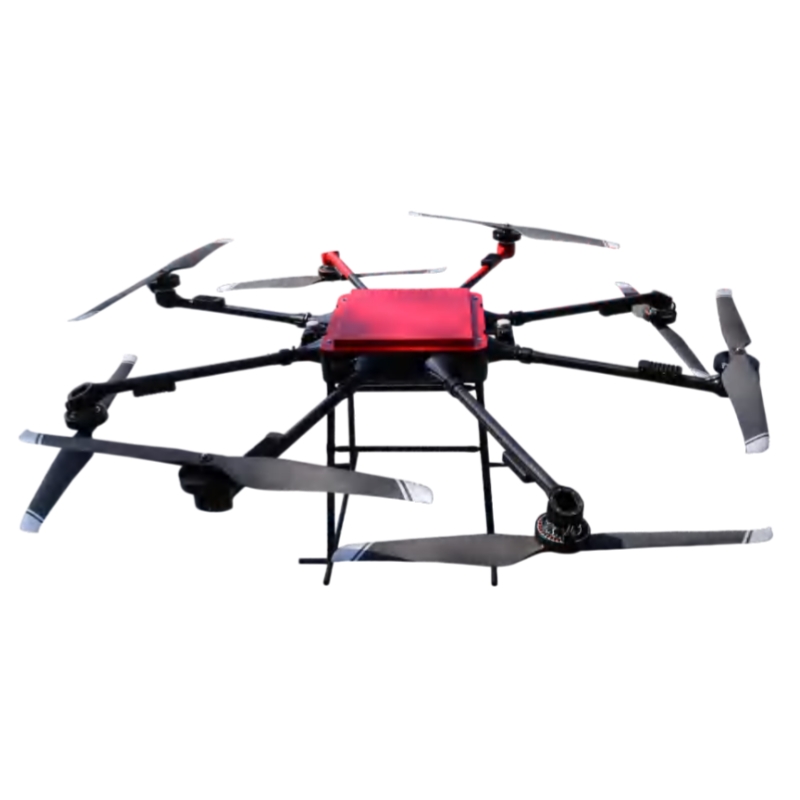
This isn’t just another drone; it’s a military-grade heavy-lift UAV tailored for the firefighting crises of MENA and African regions. Key features, as listed from your spec sheet, include:
Maximum Takeoff Weight (MTOW): 140kg.
Payload Capacity: 50kg, supporting dry chemical fire suppressants or water discharge systems.
Operation Range: Up to 5km with Beyond Visual Line of Sight (BVLOS).
Flight Stability: Tri-optical EO/IR system for precise operation, even in dense smoke environments.
Payload Configuration Flexibility: Supports dry powder, foam concentrate, or live water hose operations.
2.1 Combatting Petrochemical Fires
Class B (oil-based) fires require precision application of dry chemical agents like Purple-K. Your 50kg drone excels in petrochemical firefighting scenarios because it:
Carries 50kg of dry chemical agents to deposit it directly into the heart of the burning oil pool.
Keeps hover altitude at 15-20 meters above the flame, staying safe from heat plumes while maintaining precision.
Deploys payload in 45 seconds compared to 2-10 minutes needed for ground monitors to deploy via truck.
✔ Case Study Data: One strike from the drone (50kg of dry chemical) can extinguish up to a 10m x 10m oil pool fire. This replaces the need for manned helicopter missions, which are risky and cost over $5,000 per flight per hour.
2.2 Combating High-Rise Fires
Plane waterbombers or helicopters lack the precision required for targeting fires confined to single floors. Your drone’s innovative tether-based solution transforms high-rise firefighting.
Solution: Instead of carrying water tanks, the drone suspends a fire hose fed directly from a ground pumper truck.
The drone reaches heights between 30-40 floors (or higher), accurately positioning nozzles at the affected floors.
Multi-axis gyroscopic stabilization ensures precision targeting (±0.5m), even in high winds or unstable conditions.
✔ Real-World Data: The drone serves as an aerial stabilizer for sustained water jets, emptying a 5,000-liter tanker in one session. Its long hover time of up to 50 minutes increases effectiveness beyond helicopter “dump-and-run” tactics.
Section 3: Real-World Application Scenarios for MENA and Africa
3.1 Desert Oilfield Pipeline Fires (Libya / UAE)
Challenge: Isolated oil pipeline fires in sand dune environments are far beyond the reach of fire trucks. Ground crews risk explosion injuries.
Solution: The 50kg drone delivers a precision strike using Purple-K dry powder, suppressing flames before they spread to critical oil systems.
3.2 High-Rise Building Fires (Dubai / Egypt)
Challenge: A fire at the 35th floor of a residential tower in Cairo spreads via cladding, endangering multiple floors. Ladder trucks only reach floor 15.
Solution: The drone, tethered to a ground pumper, applies a focused water jet to the fire’s root, extinguishing flames while enabling safe evacuation for residents.
3.3 Remote Telecommunication Sites (Kenya / South Africa)
Challenge: Wildfires in rural South Africa and grassland zones in Kenya encroach on hillside telecom towers, critical for connectivity.
Solution: The drone creates retardant barriers based on 50kg drops, protecting the structure.
✔ Cost-Efficiency Note: Manned helicopters in these scenarios cost $5,000-$10,000/hour, while each drone sortie costs under $50.
Section 4: Designed for Desert Warfare–Overcoming Harsh Climates
Unlike recreational or consumer drones, your heavy-lift UAV excels in high-temperature and sandy environments:
Carbon Fiber Construction: Minimizes warping under heat, even at 45°C+ desert temperatures.
2850mm Wheelbase Rotors: Large rotors improve thrust even in thin, hot air, keeping motor temperatures optimal.
Heat Mitigation Features: Sand-resistant motor inlets and battery cooling enhancements are available via the “Desert Operations Package.”
✔ Realistic Endurance Expectation: Even at 45°C, the drone maintains an operational flight time of 20+ minutes, sufficient for most Class B and high-rise firefighting scenarios in extreme conditions.
Section 5: Economic Comparison–Drones vs. Helicopters
Feature 50kg Heavy-Lift Firefighting Drone Manned Helicopter (e.g., Bell 407)
Pilot Risk Zero High (direct over fire zone)
Operational Cost/Flight Hour <$100 $5,000 – $10,000
Deployment Time 5-10 minutes 30-60 minutes
Hover Precision ±0.5m (EO/IR vision-enabled) ±5-10m
Logistics Footprint 1 truck, 2 operators Helipad, fuel truck, full flight crew
Conclusion & Next Steps
The 50kg Firefighting Drone offers a revolutionary approach to firefighting challenges in MENA and Africa. Its unmatched safety, precision, and operational cost advantages make it an ideal alternative to helicopters for high-rise, petrochemical, and remote wildfire suppression.
To advance this solution for your organization, we recommend:
Demo Request: A live test simulating a 10m x 10m oil fire or high-rise setup.
Desert Ops Documentation: Request specs for sand-resistant modifications.
Economic Simulation: Partner with us to calculate cost savings versus manned assets.
Contact Information
Visit https://www.chinaarmysupplier.com or leave a message referencing “50kg Fire White Paper” for direct consultation. Let us future-proof your firefighting strategies for MENA and Africa today.